
Webinar Description:
Many clinicians work with individuals whose suffering persists despite years of thoughtful, dedicated psychotherapy. Clients with histories of developmental trauma may continue to struggle with dysregulated arousal, dissociation, and an enduring sense of instability even when insight, motivation, and strong therapeutic relationships are present. These challenges reflect the reality that trauma is often held and encoded within the nervous system itself, particularly in early developmental experiences that shape patterns of regulation long before language or explicit memory are available.
Building on the theoretical foundation introduced by Frank Corrigan and Sebern Fisher regarding Deep Brain Reorienting (DBR) and neurofeedback, this presentation focuses on the clinical application of these approaches in psychotherapy. Attuned Neurofeedback and DBR offer complementary ways of working directly with nervous system processes involved in regulation, orientation, early shock physiology and survival-based patterns of activation.
This webinar introduces key concepts behind a clinical model for integrating these modalities in practice. Participants will be introduced to ways clinicians may think about assessing nervous system states, supporting stabilization through neurofeedback, and considering how DBR may facilitate the processing of trauma responses held within deeper survival systems. Attention will be given to clinical pacing and the importance of ensuring sufficient nervous system stability before engaging in deeper trauma processing. The presentation offers an overview of the clinical reasoning behind this integration, with the understanding that developing skill in this approach requires more extensive training and supervision.
If you cannot attend the live webinar, all paid registrants will receive a recording of the webinar. However, CE credits are only available for attending the live presentation. This program, when attended in its entirety, is available for 1 CE credit. Purchase your CE credit as you register. The CE certificate is a separate fee of $10.00 for 1 CE credit.
Continuing Education:
- CE certificate is a separate fee of $10.00 for 1 CE credit for this presentation. Registrants who have paid for a CE certificate will receive the APA-approved certificate; the ISNR certificate is available upon request by emailing continuinged@ISNR.org (included with payment for CE certificate).
- Purchase the CE credit as you register.
- This program, when attended in its entirety, is eligible for 1 CE credit.
- Evaluations and certificates will be distributed following the presentation.
Credits:
BCIA will issue 1 credit (either ISNR or APA) towards BCIA re-certification for full attendance at this webinar.
IQCB will issue 1 credit (either ISNR or APA) toward IQCB recertification for full attendance at this webinar as non-qeeg specific credit.
Satisfactory Completion:
This webinar provides 1 CEs sponsored by the International Society for Neuroregulation and Research (ISNR), which is approved by the American Psychological Association to sponsor continuing education for psychologists. This webinar is accredited by the ISNR Neuroregulation CE Program which is designed in accordance with ISNR's requirements of Continuing Education. ISNR maintains responsibility for this program and its content. For more information about ISNR or to inquire about membership, please visit www.ISNR.org.
Most states accept continuing education courses offered by either CE Sponsors for APA or will accept the approval of other state licensing boards of the same license type. Some states, either do not require pre-approval of courses, or will allow licensees to retroactively file for course approval themselves. Check with your board to obtain a final ruling.
Who is the Audience: Psychologists, mental health clinicians, medical providers, social workers, educators/researchers, students, etc.
Level: Introductory, Intermediate
Agenda:
12:00pm - 12:50pm Presentation
12:50pm - 1:00pm Q&A
Location: Zoom
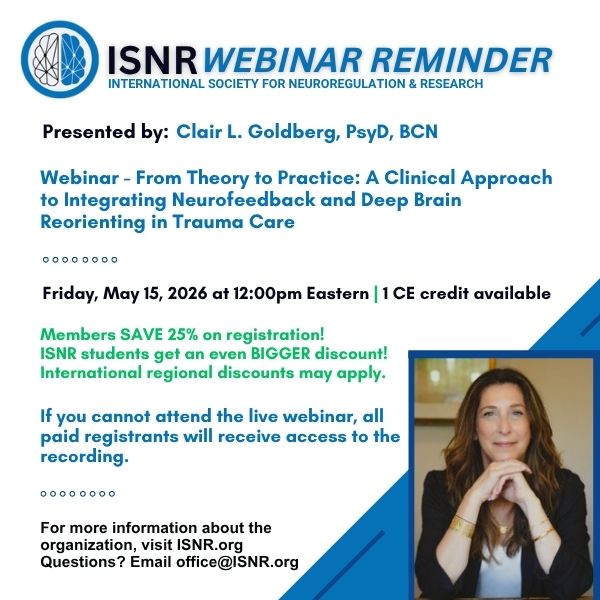
Presenter: Clair L. Goldberg, PsyD, BCN
Specific Learning objectives:
Based on the content of this presentation, the participant will be able to:
- Describe the clinical rationale for integrating Attuned Neurofeedback and Deep Brain Reorienting when working with trauma and nervous system dysregulation.
- Identify key clinical considerations—including client readiness, clinician skill, and treatment conditions—that influence decisions about integrating neurofeedback and DBR in psychotherapy.
- Differentiate clinical situations in which stabilization through neurofeedback may support readiness for trauma processing using Deep Brain Reorienting
You will receive an email containing the link to join the webinar one week, one day, and the morning before the event. Please ensure that you test your access to Zoom at least two hours before the webinar begins.
If you cannot attend the live webinar, all paid registrants will receive a recording of the webinar. However, CE credits are only available for attending the live presentation. This program, when attended in its entirety, is eligible for 1 CE credit. The CE certificate is a separate fee of $10.00 for 1 CE credits. CE credits are sponsored both by APA and ISNR.
Disclosures: Nothing to disclose
Please address questions, concerns and any complaints to Susan Alvarez, ISNR Executive Administrator:
ISNR 2146 Roswell Road, Suite 108, PMB 736, Marietta, GA 30062
Tel: 703-848-1994
office@ISNR.org
Instructor: Clair L. Goldberg, PsyD, BCN
Clair Goldberg, PsyD, BCN is a clinical psychologist known for her work integrating neurofeedback and Deep Brain Reorienting (DBR) to advance nervous system–informed approaches to trauma treatment. Drawing on more than two decades of clinical experience, she integrates Attuned Neurofeedback and DBR to address developmental trauma, early shock physiology, and persistent patterns of nervous system dysregulation. Her work reflects a deep understanding of both the neurophysiology of trauma and the relational conditions that support healing.
Dr. Goldberg has developed a unique clinical model for integrating neurofeedback and DBR that emphasizes therapeutic presence, careful clinical pacing, and working directly with nervous system processes where trauma is held. Her work contributes to emerging efforts in the field to bring together brain-based and relational approaches to trauma treatment.
She teaches and presents nationally and internationally on the neurophysiology of trauma, neurofeedback and trauma treatment, therapeutic presence in clinical work, assessment and neurofeedback, and the integration of DBR and neurofeedback.
Board Certified in Neurofeedback (BCN), Dr. Goldberg is co-developer of the Attuned Neurofeedback Training Program and mentors clinicians seeking to integrate neurofeedback and Deep Brain Reorienting in trauma-focused psychotherapy.
Refund/Cancellation Policy: If you sign up and pay for a webinar but are unable to attend the live presentation, you will be provided with access to the recorded webinar; refunds will not be issued.
ISNR is committed to accessibility and non-discrimination in its continuing education activities. ISNR is also committed to conducting all activities in conformity with the American Psychological Association's Ethical Principles for Psychologists as well as ISNR's Code of Ethics. Participants are asked to be aware of the need for privacy and confidentiality throughout the program. If program content becomes stressful, participants are encouraged to bring their concerns up during the question and discussion period, typically held at the end of the presentation. A moderator will be available during the presentation. If participants have special needs, we will attempt to accommodate them.
Because these presentations will be done online, it will be the responsibility of the participant to provide adequate and appropriate computer availability as well as internet connections that will support this webinar. All efforts and reasonable accommodations will be made to make the information accessible to persons with disabilities.
While this presentation offers no risk in and of itself, it is the responsibility of the individual attendee to determine any risks involved in the implementation of the contents of this presentation.
From Theory to Practice: A Clinical Approach to Integrating Neurofeedback and Deep Brain Reorienting in Trauma Care presented by Clair L. Goldberg, PsyD, BCN
- Friday May 15 2026, 12:00 PM - 1:00 PM
-
12:00 noon Eastern Time
Presented via Zoom
United States